Posts

Showing posts with the label high performance

Tilt-Turn Windows: Why the Smartest Builders Are Making the Switch

Image
Hey! It’s fenestrationguy here— after a long silence, I am back and today I'm serving up another real-world insight straight from the jobsite and the design studio. Today we’re tackling a quiet revolution in home design:   swapping out the standard casement and double-hung windows for high-performance European tilt-turns . Let’s dive into why it’s more than a trend—it’s a total rethink of how we build. Old Standards, New Problems:  Double-hungs and side-hinge casements have been the North American standard for decades. But as we push for better envelopes, higher efficiency, and tighter buildings, these old systems start to show their age: Leaky sashes hurt airtightness Clunky mechanics and outdated design Aging hardware = early replacements It’s time for something smarter.   What’s a Tilt-Turn Window?  Imagine one sash that does double duty: Turn the handle 90°—it opens inward like a casement door. Turn the handle 180°—it tilts from the top for gentle ventilation. Si...
Thermal Break vs Thermal Bridge - In Buildings & Windows

Image
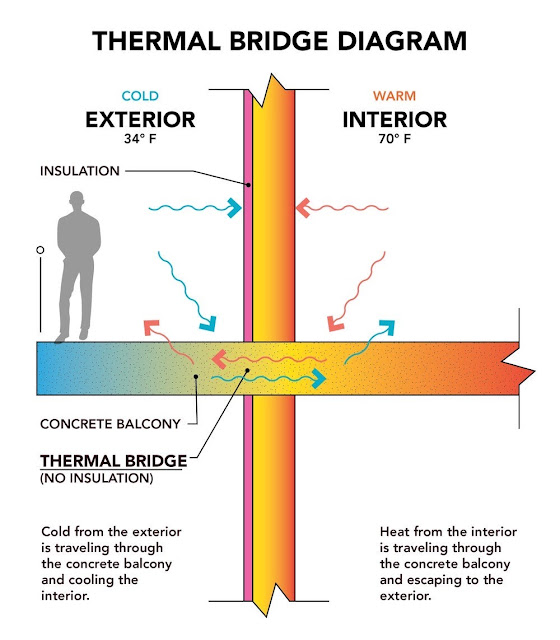
Thermal Bridge vs  Thermal Break If you’re new to building science these terms may seem esoteric but hopefully you will come to a better understanding of them after reading this.  Think of the term thermal as HEAT .  Think of term bridge   (in thermal bridge) as a connection between point A and point B - which is what an actual bridge is. So thermal bridge is simply the act of heat transporting through or on the “bridge” from point A to point B. Think of the word break (in thermal break) as in shutting down a lane of traffic on that “bridge.” Now it’s a one lane road, cars are going much slower and there is a greatly reduced number of vehicles crossing. During peak hours more cars might travel through then other times of the day. But nonetheless there has been a great interruption. In terms of heat transfer (or thermal bridge), once a thermal break is incorporated, heat (and cold) has a much harder time traveling from point A to point B.  Heat/...

5 Key Benefits of Casement Windows

Image
What is a “Casement” window? If you are not familiar with the term casement window it simply refers to a window style where the entire window (particularly the sash) opens out like a door. There are also awning windows where they open out from the bottom. Casement windows can often be ordered in two different forms of operation. The 1st being a crank out style where you need to unlock the window first and then using the hand crank located at the bottom (see photo), crank the window open. The 2nd style is manual push out casement. This is where you have to physically push out the window (or sash), there is no cranking involved. This is how casement windows originally started and some companies still offer this style. There are pros and cons to both styles but today I’m simply sharing 5 key benefits casement windows (crank out and manual openers) offer over other style of operable windows. Manual Push Out Hardware Crank Out Casement Cohesive Aesthetics  There is no doubt that windows...

Multi-Point Locking Hardware for Swinging Doors: What Are They & Benefits They Provide

Image
What is a multi-point locking hardware? They are exactly what it sounds like, a door that locks in multiple points throughout the doors edge. If you think of a traditional door with a standard deadbolt the door will have two holes bored in it (see picture in figure a). One for the knob/lever and one for the deadbolt. A multi-point locking system often times utilizes a deadbolt but in addition to a deadbolt, they have a strike/tongue/latch that gets "thrown" into the door jamb in (usually) 3 locations. See Figure B for a close-up of what the hardware looks like Figure A: Standard Door Prep    Figure B: Multi-Point Hardware Benefits: 1) Security: The first thing that people like about these systems is the obvious added security. It’s much harder to kick a door down with a multi-point engaged. Secondly it’s also more difficult to pick a lock that has a multi-point system installed.  2) Air tightness: Something that people don’t typically think about when seeing this hardware...